

Timothy Speed (b. 1973, Middlesbrough, UK) is a British–Austrian neurodivergent artist, author and researcher whose work constitutes a rare autistic tradition of knowledge production. In his oeuvre, artistic practice, scientific theory, and personal existence are not separate domains but identical structural operations. Reality, cognition and labour arise from the same operatoric processes. Speed has lived and worked in Germany for nearly thirty years (Berlin–Brandenburg region) after a formative period in Austria. He is the father of three children and lives with a feminist artist and their child south of Berlin.
Trained in film and media under Richard Kriesche (HTBLA Graz), Speed developed early on a mode of artistic research that treats the world not as an object of representation but as a research apparatus. His work combines aesthetic practice, political intervention and a non-representational epistemology into an autism-driven meta-model of mind, value and world.
Neurodivergent Architecture
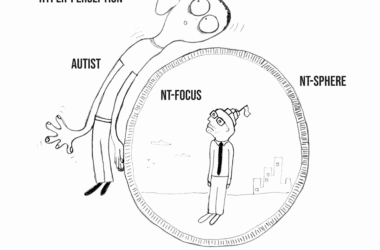
Speed works from a specific cognitive architecture (AuDHD, high pattern resolution, hyper-coherent reasoning, non-simulative intelligence) in which thought, perception and action follow operatoric invariances rather than symbolic logic. Insight does not occur despite autism but through autism: identity, truth and work form a single system; simulation, role-adaptation and external control collapse the cognitive apparatus instead of stabilising it. This dynamic is central to his scientific framework.
The Inner Laboratory
Speed describes his research mode as an inner laboratory — a permanent, embodied domain in which perception, affect, cognition and action are cyclically interwoven. This laboratory operates enactively rather than representationally: reality is not observed from a distance but is generated, transformed and re-ordered through work, relation and resonance.
His practice intersects with, yet exceeds, discourses such as:
Karen Barad’s agential realism
Donna Haraway’s situated knowledges
Robin Wall Kimmerer’s relational ecology
Melanie Yergeau’s, Nick Walker’s and Damian Milton’s theories of neurodivergence
While these approaches foreground embodiment and positionality, Speed goes further: embodiment, identity and vulnerability are not the context of knowledge but its epistemic infrastructure. Truth is not an external criterion but a mode of being.
Autistic Science
Speed’s work formulates the foundations of a post-neurotypical scientific culture — one not calibrated by objectivity, simulation, optimisation or professional role performance, but by:
structural coherence
resonance across domains
cognitive integrity
truth-bound action
existential responsibility
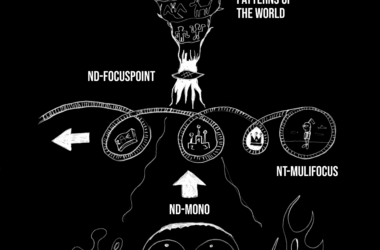
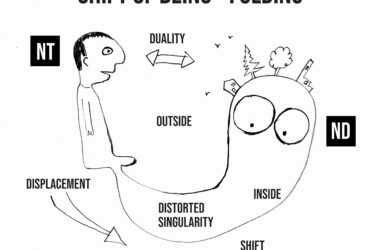
Across his books, films and long-term interventions, Speed introduces a set of structural models and operator systems — including the MNO Theory, the concept of Ontic Displacement, the theory of Mythological Existence, the principle of Autistic Vocation, the Diversity Threshold and Value Boundary, the Rosetta-Operator, and the model of Implosion Economics.
These are not isolated ideas but components of a unified operatoric ontology integrating economics, labour, poverty, consciousness, physics, autism research, media theory and social analysis.
Position
Speed stands outside institutional paradigms not out of rejection but because his knowledge practice can only emerge outside neurotypical epistemic constraints. His work foregrounds what contemporary societies marginalise: cognitive integrity as a social resource, and autistic intelligence as an autonomous research tradition capable of generating new scientific architectures rather than merely contributing to existing ones.
Short Version (Citation / Press)
Timothy Speed is a neurodivergent artist and researcher whose work establishes a rare autistic scientific tradition.
He develops a meta-model of world in which knowledge is not distanced but embodied, resonant and existentially bound. His oeuvre challenges foundational assumptions about science, labour and subjectivity and opens the horizon for a post-neurotypical epistemology.