
Why this work matters for autism research
(2-page statement)
This body of work (11 books by Timothy Speed) represents the first long-term, introspectively documented account of how an autistic mind performs cross-domain, meta-level pattern construction — not as a cognitive exercise, but as a lived epistemic architecture. It therefore offers a missing component to autism research: an internal, first-person, phenomenologically stable description of high-systemising, monotropically organised cognition across three decades.
Speed’s work demonstrates veridical mapping in its pure form: the repeated, lifelong construction of structural isomorphisms across independent domains. These isomorphisms are not extracted analytically, but enacted and embodied, condensed into operators and stabilised on a meta-theoretical level. This is what makes the texts scientifically unique.
Speed’s theoretical development does not proceed from external observation to internal abstraction, but from internal resonance to external articulation. Systems are not analysed from the outside, but enacted from within until their organising logic becomes experientially available. This produces operators that generalise across domains, leading to repeated structural convergence rather than domain-bound theorising.
Current autism science operates primarily through external observation: behavioural measures, questionnaires, neuroimaging, clinical interviews, lab tasks and psychometrics. The heterogeneity of autistic cognition is widely recognised, yet the mechanisms by which certain autistic individuals generate complex models of reality across multiple domains remain under-described. The existing literature on hyper-systemising and veridical mapping explains what such individuals can do — but not how they think, nor how this cognition develops over time inside a life.
This work fills that gap.
1. A rare window into the mechanism of cross-domain veridical mapping
Research has documented that some autistic subjects are capable of identifying structural isomorphisms across domains, a phenomenon referred to as veridical mapping. However, no study has provided a self-authored, lifelong trace of how such mapping unfolds cognitively, emotionally and developmentally.
Across the full corpus, Timothy Speed demonstrates:
the formation of recursive structural operators that remain stable across subject areas
the progressive generalisation of patterns from personal, social, economic and political contexts
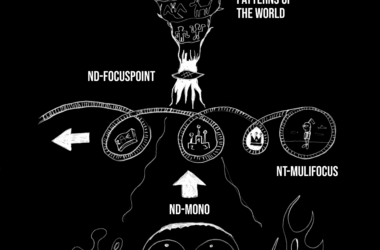
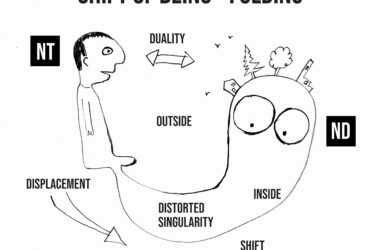
the consolidation of these operators into explicit theoretical models (e.g., MNO, Seinsverschiebung, mythological existence, Diversitätsmarke)
This progression is visible over thousands of pages written across thirty years, offering an empirical record of a cognitive process that has previously only been inferred externally.
2. Integration of hyper-systemising and enactive cognition
Two contemporary paradigms are often treated separately:
| Paradigm | Focus |
|---|---|
| Hyper-systemising | Structural patterning and rule formation |
| Enactive / embodied accounts | Sense-making through lived experience and intersubjective engagement |
The corpus shows that, in some autistic individuals, these are not oppositional but synergistic.
Speed’s cognition does not map patterns from the outside; it lives through systems until their logic becomes experientially available. This adds an important third pattern to autism science:
Some autistic thinking is simultaneously structurally analytical and experientially embodied.
This dual mode has not been formally modelled in autism research because individuals who embody it rarely generate written, longitudinal self-documentation.
3. Evidence that mapping is not a “talent” but an identity-level organising principle
The corpus makes visible that, for some autistic individuals:
pattern-mapping is not optional,
not domain-specific,
not motivated by external reward,
and not reducible to “special interest”.
It functions as a primary form of world-construction and self-construction.
This suggests that high-systemising autism should not always be conceptualised as a skill profile, but sometimes as a fundamental ontology of cognition.
This distinction has significant implications:
clinically (misdiagnosis as personality disorder or obsession),
socially (chronic mismatch with normative communication),
educationally (inability to engage in non-meaningful activity),
economically (high competence yet low employability),
and scientifically (underrepresentation of this phenotype in research samples).
4. Empirical support for the double-empathy framework
Rather than framing mismatch between autistic and neurotypical individuals as a one-sided deficit, the corpus offers rich observational material showing that:
autistic cognition expects coherence, consistency and truth-orientation,
neurotypical cognition expects social alignment, ambiguity tolerance and reciprocity of appearances.
This directly supports the double-empathy paradigm by demonstrating that misattunement emerges from differences in meaning-making, not social failure.
Unlike most double-empathy studies — which analyse interpersonal behaviour — this work exposes the experiential interior of the autistic side of the interaction.
5. A longitudinal dataset of autistic cognition under real-world pressure
The texts unintentionally document:
masking and its breakdown,
burnout and monotropism overload,
trauma from forced simulation in institutions,
resilience through deep engagement in meaning,
long-term effects of social non-recognition,
and identity maintenance through epistemic integrity.
It is difficult to overstate the scientific value of an unsolicited 30-year record of cognition, adaptation, collapse and reconstruction, written in real time — not retroactively.
There is no comparable dataset in autism research.
6. A vocabulary for missing phenomena
The work contributes a set of conceptual terms that describe phenomena for which the field currently lacks language:
autistic vocation — monotropism as existential necessity
mythological existence — embodied epistemic identity
Seinsverschiebung — identity restructuring under cognitive-affective load
Diversitätsmarke — threshold of cognitive heterogeneity in systems
MNO — operator-level meta-mapping of structure across domains
These terms are not poetic; they are functional, capturing cognitive and experiential realities that current psychiatric and psychological vocabulary cannot describe without distortion.
7. Why this corpus matters now
Autism research is shifting:
from deficit to difference,
from behaviour to cognition,
from external observation to internal experience.
The next scientific challenge is:
to understand how autistic cognition generates meaning — not only what autistic behaviour exhibits.
This work is positioned exactly at that frontier.
It does not replace existing autism research — it completes a missing dimension:
observation from the outside
→ already availableobservation from the inside
→ for the first time documented at scale
In one sentence
This work matters because it gives autism research access to something it has never had: a direct, longitudinal, cognitively precise, theoretically mature record of how a high-systemising, monotropically organised, enactive autistic mind constructs meaning across an entire life.