
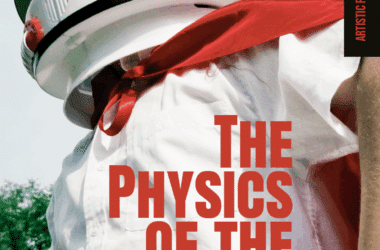
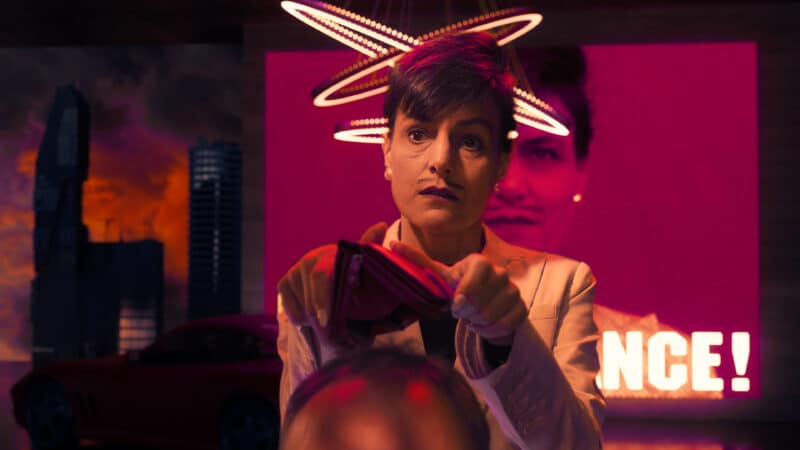
Transferprotokoll” is a science-fiction comedy (a grotesque comedy) about poverty, the value of work, individual contribution, and self-empowerment in our capitalist society.
THE STORY
After 30 years of mostly unpaid work as an artist, labor researcher, and poverty researcher, Timothy Speed is finally bankrupt and falls into the clutches of the deranged job placement officer Ms. Redlich. Her job center is located inside a gigantic bust of Facebook founder Mark Zuckerberg, where poor people must do everything they can to be liked. Stigmatized, left behind, and pushed to the margins of society, Speed finds himself in free fall. But he has a plan. By founding a new economy and a new form of work, he aims to finally free humanity from poverty.
Timothy Speed understands film as a means of intervention, of personal engagement and taking responsibility within society. The work is a bridge to people, without claiming intrinsic value in and of itself.
The debate film “Transferprotokoll” is an autistic-migrant film, told from the perspective of the excluded, of those displaced from society. Speed does not narrate from the outside as a self-contained story, but always through himself, thereby breaking conventions. He exposes political scandals and denounces massive misconduct by real German authorities, civil servants, and ministers, whom he names explicitly:
“We do not live in a time in which it is enough to tell beautiful stories. The medium must show more, enable more. Breaks, conflicts, dialogues about things and conditions that concern us all — or concern a single person so deeply that their cry must not be obscured or marginalized by any aesthetic.”
In the leading roles appear Timothy Speed, Kirsten Nehberg (Hasenjagd, Bella Block, Großstadtrevier, True Crime: Tatunca Nara and the Dead in the Jungle/ARD), Lulu Bail (Die Rosenheim-Cops, Polizeiruf 110), Adisat Semenitsch (Dani Levy/Silent Night, Dieter Hallervorden/Zebralla, 3Sat series/Für alle Fälle Stefanie), and Serkan Sahan (ZDF Sibel & Max / RTL GZSZ).
Guest appearances include Katja Kipping of Die Linke, as well as the Hartz IV activist Inge Hannemann, among others.
The film can be downloaded here with english subtitles for academic purposes.
IMDb Link: https://www.imdb.com/de/title/tt32341604/?ref_=fn_i_1
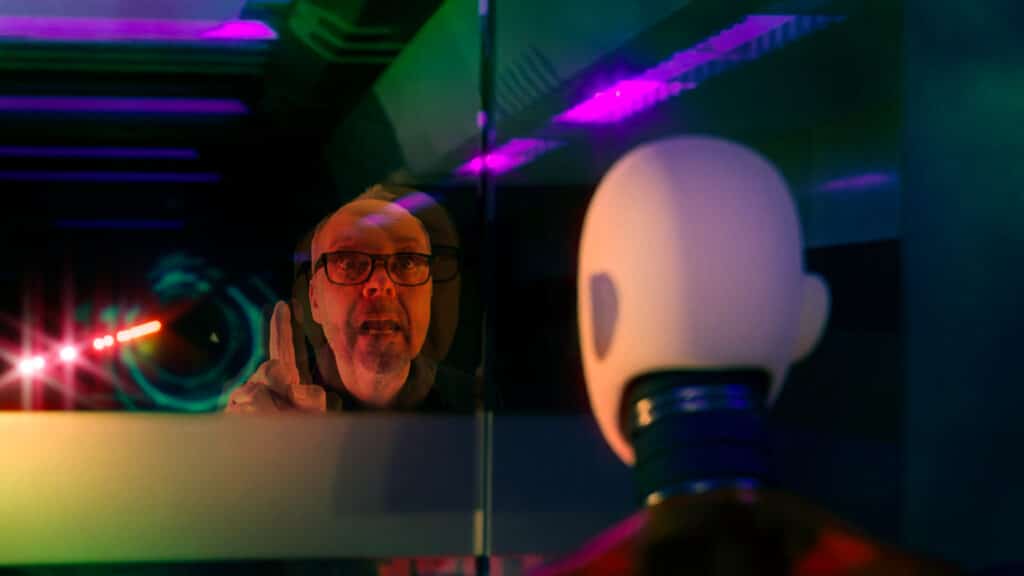
Film as Artistic Research
It is also about the reaction to the film, which is itself part of the film. As a project in Artistic Research, Transferprotokoll not only documents and journalistically proves serious crimes against poor people by real ministers, public prosecutors, judges, and civil servants, but also shows how the Hartz IV system (Bürgergeld) made and continues to make people in Germany ill. A fact that was and is known, yet against which, unfortunately, not enough prominent resistance has emerged. The film exposes the social racism that this society carries along with its shift to the right.
In this context, Speed himself plays an “impossible victim figure” that deliberately breaks clichés. As a white man, his attempt to save the world makes him simultaneously a clown and the personification of hope—and for this he is punished by society with a prohibition of identity. Timothy Speed plays with the impermissible, the unwanted, the unbearable, thus throwing the question of justice back to the audience as a complex dialectic, returning it to the consumers. This becomes possible precisely because he is not, and cannot be, a clear hero within the story.
The film is accompanied by extensive empirical research and journalistic undercover work, which was also published as the book Speeds Arbeit. The film is more than just a film; it is the beginning of comprehensive revelations about the state’s treatment of people living in poverty.
Speed’s method makes visible the relationships between individual and society by simultaneously pulling everything into the personal realm and thereby challenging institutions. In doing so, he resists simplification and exclusion and uses the individual—himself—as a resistant obstacle against what is easily digestible. Against the disappearance of subjective individuals. He does this in order to create complexity, which for him is the foundation of a free, humane, and open society. That Speed never fits is a postulate of hope for alternatives.
Transferprotokoll is a total performance that seeks to tell us something about society and about the difficulty faced by the individual in finding a place and a lifeworld within it.
With this film, Speed challenges society and its institutions.
Transferprotokoll is not a distanced film, but a scandal—because it directly targets the problems of our society and does so without regard for whether the film can be successful in the process.
It was therefore clear that the film would entail a confrontation with the public broadcasting corporations, see this open letter to the Chair of the ARD, Kaj Gniffke:
Open Letter to the Chair of the ARD
SWR
Prof. Dr. Kai Gniffke
Director-General
Neckarstraße 230
70190 Stuttgart
22 September 2024
Open Letter
Dear Director-General, Prof. Dr. Kai Gniffke,
Thank you for your letter of 19 September 2024. I would like to respond here with an open letter.
In research, we speak of the “culturalization of art” when attempts are made to confine it to a harmless niche so that it disturbs society as little as possible. One also speaks of the ghettoization of art. Adorno and Walter Benjamin warned against “aestheticization instead of politicization,” by which they meant that art is not infrequently stripped of its political dimension when it is negotiated solely on the level of aesthetics, that is, formal discourses. The development that Adorno and Benjamin sought to prevent is now visible everywhere in public broadcasting—especially when it comes to program selection.
You select according to criteria of aesthetics, formally and in terms of content, but you are incapable of enduring disruption. When confronted with the accusation of a lack of diversity in the sense of representing the fracture lines of this society, you respond by pointing to the “curated diversity” you provide. In doing so, you presume to believe that you know better what society needs than the independent scene on the ground—than the people who experience grievances and can report on them authentically, instead of merely commenting from the outside. This is a fatal mistake.
Depoliticization of art means that art is removed from its critical and social context and turned into a harmless, consumable product. By depoliticizing art, it is made part of a niche that can no longer exert influence on broader social developments. This is particularly dangerous when a society is sinking into a shift to the right.
In your letter of 19 September 2024, one can recognize this danger—one that you are presumably not aware of. You initially write about the film:
“Your film Transferprotokoll is a hybrid mix of social satire, docufiction with elements of the science-fiction genre, an artistic self-portrait, and a sharply argued thesis film. In your satirical engagement with the topic of poverty, you turn the tables and accuse German bureaucracy in order to present your view of social power structures in a pointed way. One can rub up against your work aesthetically and politically.”
This assessment is correct. But you then go on to write:
“Nevertheless, our impression is that problems with Hartz IV or today’s Bürgergeld and the associated criticism require a different form of mediation for our audience.”
“Your audience,” forgive me for the sharpening of the point, thus appears to be senile, stupid, uneducated—in short, you do not trust it to deal independently with art. Not even with criticism of the Bürgergeld system that is not mainstream, that does not correspond to the usual classist racisms directed at discriminated groups, which are all too readily reproduced by public broadcasters as well. And certainly not when these grievances are described by someone who has experienced this contempt for human beings firsthand and therefore breaks through the strategies of distance employed by those who prefer to look away.
“Your audience” is treated by you as though it depended on your judgment, on your ability to decide what is good or bad for it. Because this claim is hardly compatible with a stance of integrity, you choose interchangeability and mediocrity. In the “safe space,” you evade responsibility as public broadcasters.
You are a white man in an extremely privileged position. I am a migrant living in precarity and a cultural producer who is being pursued by right-wing extremists in Brandenburg and who has tried, with very limited means, over four years of unpaid work, to do something about these conditions by making a film together with the actors—without money.
Forgive me, then, if my language is not sufficiently comfortable for “your audience”! How could it be, when I had neither your resources nor your budget at my disposal, nor your cynicism regarding the question of whether films from the independent scene are understood by the majority—or are simply useless. You push those who are already marginalized ever further out of public discourse and thereby do the work of the Right. You do this tragically in the belief that you are preserving “balance,” which you misunderstand as a frictionless zone.
Your decision weakens civil society and narrows the corridor of discourse—an accusation that has already been made against you often enough, fatally and most loudly by the Right.
This does not affect only me; large parts of the arts are today threatened by the Right. With your letter, you imply that our work is of no concern to society, that art is a product that must not impose itself. You misunderstand your cultural mandate. According to your view, we are not supposed to disturb. In doing so, you once again render public broadcasting insignificant for democratic discourse.
The film Transferprotokoll is an imposition. That is true. But the question is: is it not precisely this imposition—which does not seek to be right, but to serve a discourse—that, in times when 30% in the East vote for fascists and a right-wing populist like Friedrich Merz, who engages in incitement against the poor, could soon become Federal Chancellor, a film that we should all impose upon ourselves? Why are poor people not allowed to express themselves freely on ARD and SWR? What vested interest are you seeking to preserve here as a privilege?
I ask you to reconsider your decision, which will now become a decision of civil society. You could simply contextualize the film. Poor people certainly deserve the effort to situate their perspective and give it space in the same way that is done for the works of VIPs. You can even distance yourselves from the film—but show it! If art is not shown because it creates friction, then with what are we to effectively combat fascism, that is, enforced conformity? Thousands of poor people, migrants, and cultural producers are massively threatened by a renewed shift to the right. Do not silence us!
We as the audience do not belong to you, and we do not want to belong to you. In times like these, programming decisions must not be left solely to editors for whom topics are interchangeable—because we, with our suffering and our concerns, are not.
The independent scene, the marginalized, demand a seat at the table.
Sincerely,
Timothy Speed